Welcome to the first episode of our climate cluster. This isn’t a series about whether “the science is real” on climate change. This is a series about what the science says — and what it means for our lives, our politics, and our future. I suspect I’m like a lot of people in that I accept that climate change is bad. What I struggle with is how bad. Is it an existential threat that eclipses all else? One of many serious problems politics must somehow address?
I wanted to kick off the series with someone who knows the science cold. Kate Marvel is a research scientist at NASA’s Goddard Institute for Space Studies and a professor at Columbia University’s Department of Applied Physics and Mathematics. But Marvel isn’t just a leading climate scientist. She’s also unique in her focus on the stories we tell each other, and ourselves, about climate change, and how they end up structuring our decisions.
We discuss:
How a climate model actually works
Why this is the good place
Why there is so much variation in climate scientists’ predictions about global temperature increases
Why global warming is only one piece of the much larger problem of climate change
Why a hotter planet is more conducive to natural disasters
The frightening differences between a world that experiences a 2°C temperature increase as opposed to a 5°C temperature increase
Whether the threat of climate change requires solutions that break the boundaries of conventional politics
The underlying stories that animate much of the climate debate
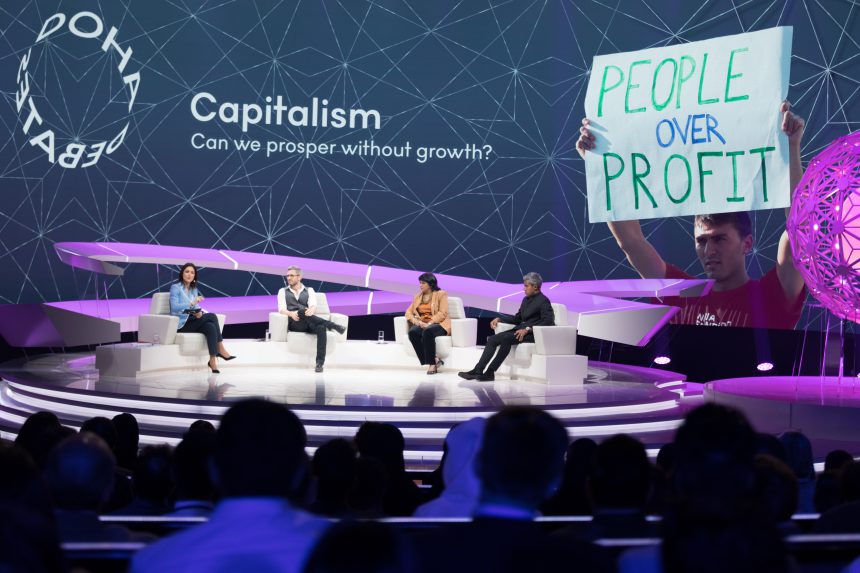
Whether the planet can sustain continued economic growth
What it means to “live morally” amid climate change
Welcome to episode 2 of our climate cluster. The more I prepared for this series, the more I realize there was a big blue gap in my understanding of climate change. Oceans cover 70% of the earth, absorb 93% of the heat from the sun, and capture 30% of the carbon dioxide from the atmosphere. Forty percent of the world’s population lives within 60 miles of the coast, and half a billion people rely on oceans as their primary food source. As go the oceans, so goes humanity.
Dr. Ayana Elizabeth Johnson is the founder of the Urban Ocean Lab and the Ocean Collectiv, she’s held positions at the NOAA and the EPA, and was named by Outside Magazine as the most influential marine biologist of our time. And she’s able to do something a lot of people aren’t: communicate not just the science of climate change from the ocean perspective, but the role oceans play in the human story. This is not a dry, complex disquisition on climate science. This is a vivid tour of the way oceans shape our lives, and the costs and consequences of reshaping them.
Most analyses of how to “solve” climate change start from a single, crucial assumption: that carbon emissions and global warming are inextricably linked. Geoengineering is a set of technologies and ideas with the potential to shatter that link.
Can we use them? Should we? Could they be used in concert with other solutions, or would simply opening the door drain support from those ideas? Even if we did want to deploy geoengineering, who would govern its use? And is mucking with the earth at this level more dangerous than climate change itself — which may, ultimately, be the choice we face?
Jane Flegal is a geoengineering expert at Arizona State University and a program officer at the Bernard and Anne Spitzer Charitable Trust. She’s able to parse this debate with an unusual level of clarity, fairness, and rigor. This isn’t an argument for or against geoengineering. It’s a way to think about it, and that turns out to be a way to think about the climate change problem as a whole.
Dave Roberts is an energy and climate writer at Vox and a senior fellow at the Kleinman Center for Energy Policy at the University of Pennsylvania. He started as his career covering climate science and clean energy technology, but — for reasons we discuss here — he now writes just as much about political psychology, media ecosystems, political institutions, and how they intersect with climate change.
We cover a lot in this conversation, including:
“Tribal epistemology,” and why it’s crucial to climate paralysis
How the GOP went from the party of cap-and-trade to the party of climate denial
Why the right and left-wing media ecosystem’s diverged so dramatically
What today’s climate activists get right about our politics that their predecessors got wrong
The carbon tax dead-end
How nuclear energy became so divisive
The conflicting moral and social visions at the heart of the climate movement
Why it is impossible to separate technological innovation from the policy ecosystem that shapes it
Whether climate change really is an “existential” threat
What climate change will mean for the world’s poor


 Climate Front Page